“Greening the Ghetto” is the title of Elizabeth Kolbert’s profile of Van Jones in a recent New Yorker. The piece traces Van Jones’ development from a civil rights activist to a green collar jobs guru. Kolbert quotes Jones saying “Sometimes a breakdown can lead to a breakthrough.” She tells the story of how this resonates on a personal level for him. And, he’s also referring to this moment in history when an economic breakdown could lead to an environmental and economic breakthrough.
Each January for the past several years, Bill has surveyed the top Corporate Social Responsibility news stories of the past year for CSRwire.com, where he is a contributing writer. Here’s this year’s edition:
A “green” recovery from economic and environmental meltdowns; the advent of Shareholder Activism 2.0 with binding resolutions at TARP banks; CSR adopts Web 2.0 strategies for sustainability reporting; is Wal-Mart really green?; and much more…
The economic meltdown of 2008 mirrors the simultaneous environmental meltdown fueled by the climate calamity – both share common roots, and many in the Corporate Sustainability and Responsibility (CSR) community believe they share a common salvation.Read the show transcript
Today we talk with Hunter Lovins, founder of Natural Capitalism Solutions, about the Presidential Climate Action Project. The Sea Change ViewPoint comes from Charlie Cray of the Center for Corporate Policy.
For many people, the election of Barack Obama as the US President stoked hope for big change. The transition to the Obama Administration brings promise of shifts to government regulations and policies to promote sustainability. Long before the election, though, a group of influential sustainability leaders gathered to brainstorm recommendations to the incoming President on tackling climate change. The Presidential Climate Action Project was born,Read the show transcript
At the G-20 Summit addressing the global financial crisis this weekend, the government leaders of the world’s largest economies essentially twiddled their thumbs, punting on setting ambitious goals until April 2009 — when the Barack Obama Administration, which is dedicated to addressing the financial crisis and the climate crisis, is in office. Before the Summit, Worldwatch Institute Senior Researchers Michael Renner and Gary Gardner proposed that the G-20 enact a Global Green Deal, evocative of FDR’s new deal but more audacious in scope and vision. CWR co-hosts Francesca Rheannon and Bill Baue speak with Renner about the proposal’s 5 strategies, including transitioning to a renewable energy economy, launching an efficiency revolution, and investing in green infrastructure.
And speaking of green infrastructure, Deutsche Asset Management issued a report calling for the establishment of a “green” National Infrastructure Bank. Bill Baue speaks with Deutsche Climate Change Investment Research Director Bruce Kahn about the report, a followup on the Investing in Climate Change 2009: Necessity and Opportunity in Turbulent Times report CWR covered recently.
The Top BENNY Award for 2008, given to activist campaigns holding corporations accountable by the Business Ethics Network (BEN), went to the Clean Up Ecuador campaign for bringing Chevron to justice for decades of pollution in the Amazon. The campaign is led by the Amazon Defense Coalition and Amazon Watch. Mitch Anderson of Amazon Watch has our commentary today, produced in partnership with BEN.
When it comes to renewable energy, wind is taking the lead–at least at this stage of technological development. But what’s the best model for developing it? Should we follow the centralized utility model with big wind farms set up in a few places — offshore Massachusetts or the state of Texas — and then send the juice over wires to power homes and businesses far away? That’s the dominant model in the US. Or should we follow the community-owned wind power model, where the people using the power have a financial stake in it, too? Maybe a healthy mix of both would be best. Today, CWR co-host Francesca Rheannon speaks with Dan Juhl of Juhl Wind Development, which is helping communities around the country develop locally owned wind power cooperatives. The company has developed about 140 megawatts — or several hundred million dollars worth — of community-based wind projects. Francesca met him at the Sustainable Energy Summit at the University of Massachusetts in June. And Rheannon speaks with journalist Elizabeth Kolbert. Her recent New Yorker article, “The Island in the Wind,” profiles the Danish island of Samso, known internationally as the “renewable energy island” because residents get most of their power from windmills they cooperatively own.
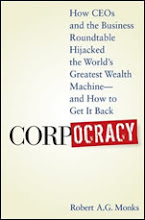
The ExxonMobil annual shareholder meeting this year carried high expectations from shareholder activists. Members of the Rockefeller family, descending from the founder of the Standard Oil monopoly that splintered into Exxon and Mobil, attended the meeting to support four different shareholder resolutions on corporate governance and climate change. Of these four, the resolution supported by most Rockefellers asked the company to split the CEO and Board Chair positions. Today’s CWR guest, Bob Monks, has filed this resolution at ExxonMobil since the early 2000s. His struggle to hold ExxonMobil accountable exemplifies the broader struggle to hold corporations accountable described in his new book, Corpocracy. Monks is co-founder of Institutional Shareholder Services, The Corporate Library, Lens Governance Advisors, and a former Labor Department official in the Reagan Administration.
Web extra: Bob Monks chats with CWR co-hosts Bill Baue and Francesca Rheannon about the US presidential candidates’ ability to take on corpocracy. Listen
CWR ViewPoint: read (Thanks to our partner CSRwire for posting text of CWR commentaries.)
Longtime shareholder activist Steve Viederman presented this statement at the ExxonMobil Annual Meeting in May 2008 to introduce resolution 19 asking Exxon to adopt a renewable energy policy. He filed the resolution along with other individuals, families, foundations and religious orders, joined by 20 institutional investors worth over $740 billion in combined assets, including Exxon Mobil stock valued at more than $8.6 billion.
In a 2006 Rolling Stone interview, Al Gore infamously likened the practice of extracting oil from tar sands to “junkies find[ing] veins in their toes” to inject heroin. Gore’s image simply extends to its logical conclusion George Bush’s 2006 State of the Union “addicted to oil” metaphor. Clean, renewable energy represents a healthy cure for petro-addiction. Tar sands, which increase the carbon intensity of petroleum extraction, represent an exacerbation of the climate-changing addiction–kind of like trying to cure heroin addiction by injecting arsenic. CWR co-host Bill Baue speaks with Shelley Alpern, director of social research and advocacy at Trillium Asset Management, about her shareholder activism asking oil companies such as ConocoPhillips and BP to assess and disclose the social, environmental, and financial risks of tar sands exploitation. We also hear from the Environmental Integrity Project and Environmental Defence Canada about their brand new report, Tar Sands: Feeding U.S. Refinery Expansions With Dirty Fuel.
Corporate Watchdog Radio co-hosts Bill Baue and Francesca Rheannon speak with Auden Schendler, who heads the sustainability program at Aspen Skiing Company and has stirred up a heap of controversy as the subject of a recent BusinessWeek cover story entitled “Little Green Lies.”
Schendler calls into question the degree to which companies, within our current capitalist structure, can actually enact meaningful change toward true sustainability. Having convinced his company to commit in a big way to renewable energy credits (RECs), he has since become disillusioned, noting that many RECs fail to add new renewable energy projects to the world, and questioning exaggerated claims of RECs’ actual impact on reducing carbon emissions.
In part two of this two-part interview, British journalist George Monbiot discusses his new book, Heat: How to Stop the Planet from Burning, with CWR co-hosts Bill Baue and Francesca Rheannon. He touches on the irony that increased energy efficiency can lead to increased greenhouse gas emissions and the promise of high-voltage DC cables in transmitting renewable energy over long distances. We end the conversation discussing the paradox that love both creates climate change (in the form of what Monbiot calls “love miles” or the distance traveled and carbon emitted to visit loved ones) and holds the key to the solution, as compassion for humanity is the greatest catalyst for changing our carbon intensive systems.

 “Greening the Ghetto” is the title of Elizabeth Kolbert’s profile of Van Jones in a recent New Yorker. The piece traces Van Jones’ development from a civil rights activist to a green collar jobs guru. Kolbert quotes Jones saying “Sometimes a breakdown can lead to a breakthrough.” She tells the story of how this resonates on a personal level for him. And, he’s also referring to this moment in history when an economic breakdown could lead to an environmental and economic breakthrough.
 Each January for the past several years, Bill has surveyed the top Corporate Social Responsibility news stories of the past year for